Odour control
Objective measurement of odour control effectiveness
In various segments of industry, in agriculture, and in food production and hot-kitchen operations alike, there is a need to effectively manage and reduce the nuisance gases and odours, sometimes harmful to health, that are generated during operation.
Odour control is no longer a matter of choice: in addition to being an expectation of residents, it is also a regulatory, environmental and permitting requirement.
However, the true value of an odour reduction solution cannot be judged on subjective impressions alone. Before an odour control technology is applied and introduced, and also during its operation, the odour impact must be measured so that the results are genuinely credible. Evaluating the odour control effect requires an objective, standardised measurement method, and this is what olfactometric testing provides.
What is olfactometry?
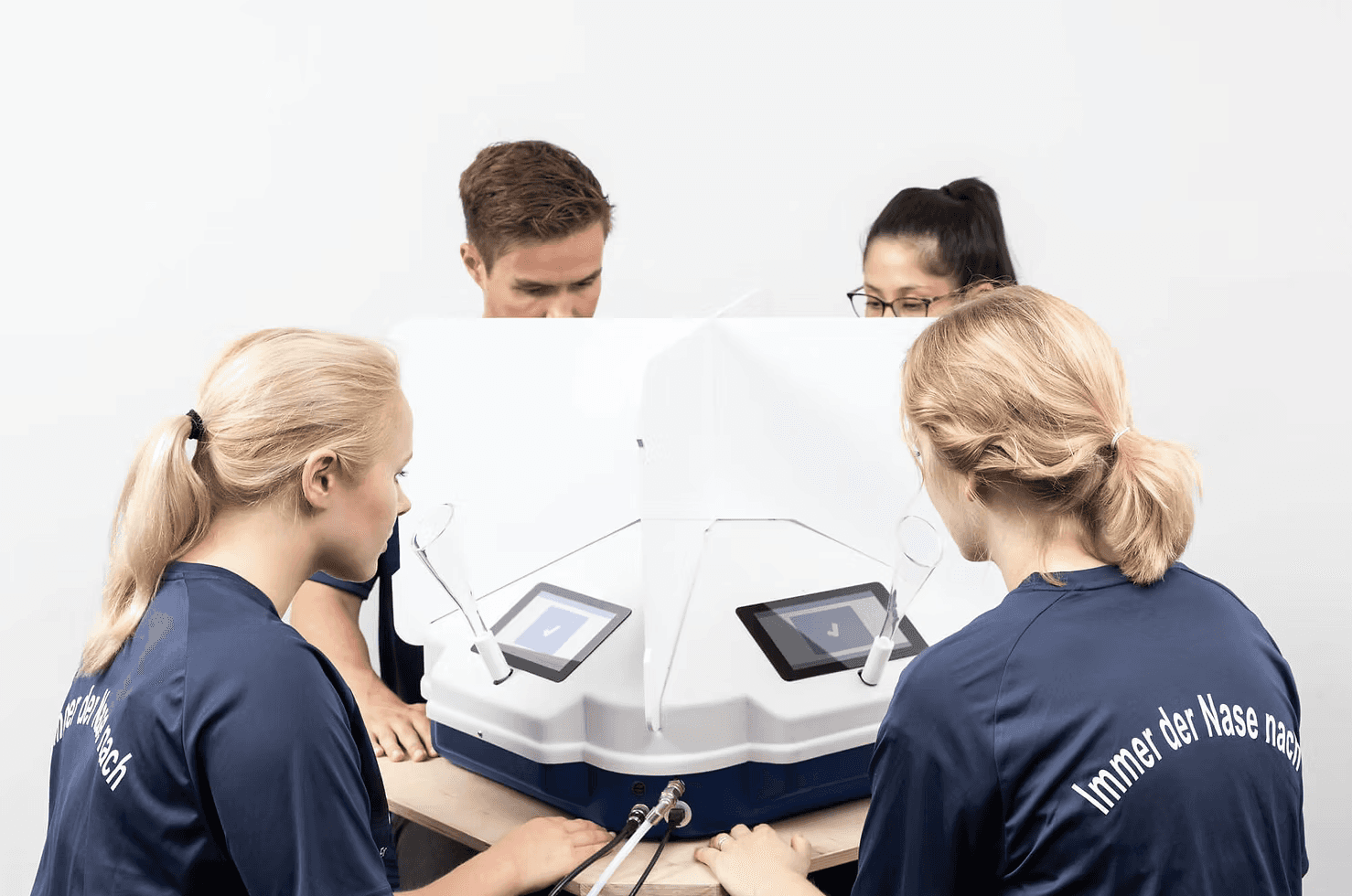
Olfactometry is the internationally accepted and most reliable method of measuring odour impact. The procedure for measuring the effectiveness of odour control technology was standardised in 2003 in the European Union and in Hungary (MSZ EN 13725) under the title "Determination of odour concentration by dynamic olfactometry".
Although the human nose plays the main role in this method too, the selection of participants, the screening of their sense of smell, the equipment used to determine concentration (the olfactometer) and the dilution procedure ensure that it can be standardised. This means that we can repeat the measurement on the same sample several times, changing the participants in between, and still obtain almost the same result every time (with very little deviation).
Since the measurement yields two values – odour concentration (odour units/m³) and odour emission (odour units/s) – it is also suitable for modelling the spatial dispersion of odours, so that the area on the map reached by perceptible odour from the source can be delineated.
Dynamic olfactometry is the most objective odour measurement method known today and the one that best ensures comparability.
How is an official olfactometric test carried out?
1. Sampling on site
The first step of the test is the professional collection of odour samples:
from a point source (e.g. stack, extraction outlet),
from an area source (e.g. wastewater treatment plant, manure storage),
or from diffuse emissions.
2. Laboratory measurement
The samples go to an accredited laboratory, where:
using a dynamic olfactometer,
the sample is diluted in several steps,
and then a validated odour panel of at least 4–6 people assesses the detection threshold.
3. Determining odour concentration
The result of the measurement is the odour concentration, expressed in:
ouE/m³ (European odour units per cubic metre), which shows how many times the air sample must be diluted before it becomes just perceptible to the human nose.
How can the effectiveness of an odour control technology be measured?
The effectiveness of odour control can be demonstrated objectively and numerically with olfactometry, typically by measuring before and after the intervention.
Comparing the two values makes it possible to determine:
the reduction in odour concentration (%),
the actual efficiency of the technology,
any further needs (e.g. installing additional odour control units).
(For example, a reduction from an initial odour concentration of 8,000 ouE/m³ to 1,200 ouE/m³ means an 85% odour reduction.)
Why is official measurement important?
The advantages of olfactometric testing:
it is a method accepted by the authorities,
it can be used in legal and permitting procedures,
it substantiates the service provider's professional performance,
it reduces disputes over resident complaints,
it provides an objective basis for investment and operating decisions.
Subjective feeling vs. measurable result
Although the perception of odour is always a subjective experience, olfactometry makes it possible to measure human perception in a standardised, reproducible way and to use it as a basis for technical and environmental decisions. This is particularly important in odour control projects, where the success of the service is proven not by promises but by the measurement report.
Olfactometric testing provides the objective measurement basis that makes odour reduction solutions comparable, verifiable and documentable.
A modern odour control service offers not only technology but also measurable results. The Telepszagtalanítás team has already proven the effectiveness of its odour control technology at many sites, in every case backed by verified measurement results.
Our free telephone consultation is available to anyone, and you can also send us your questions by email.